The Galvanizing Process: How Galvanized (GI) Coils Are Made
A complete step-by-step look at continuous hot-dip galvanizing — from cold-rolled feedstock to the zinc-coated spangle finish that defines GI Coils.
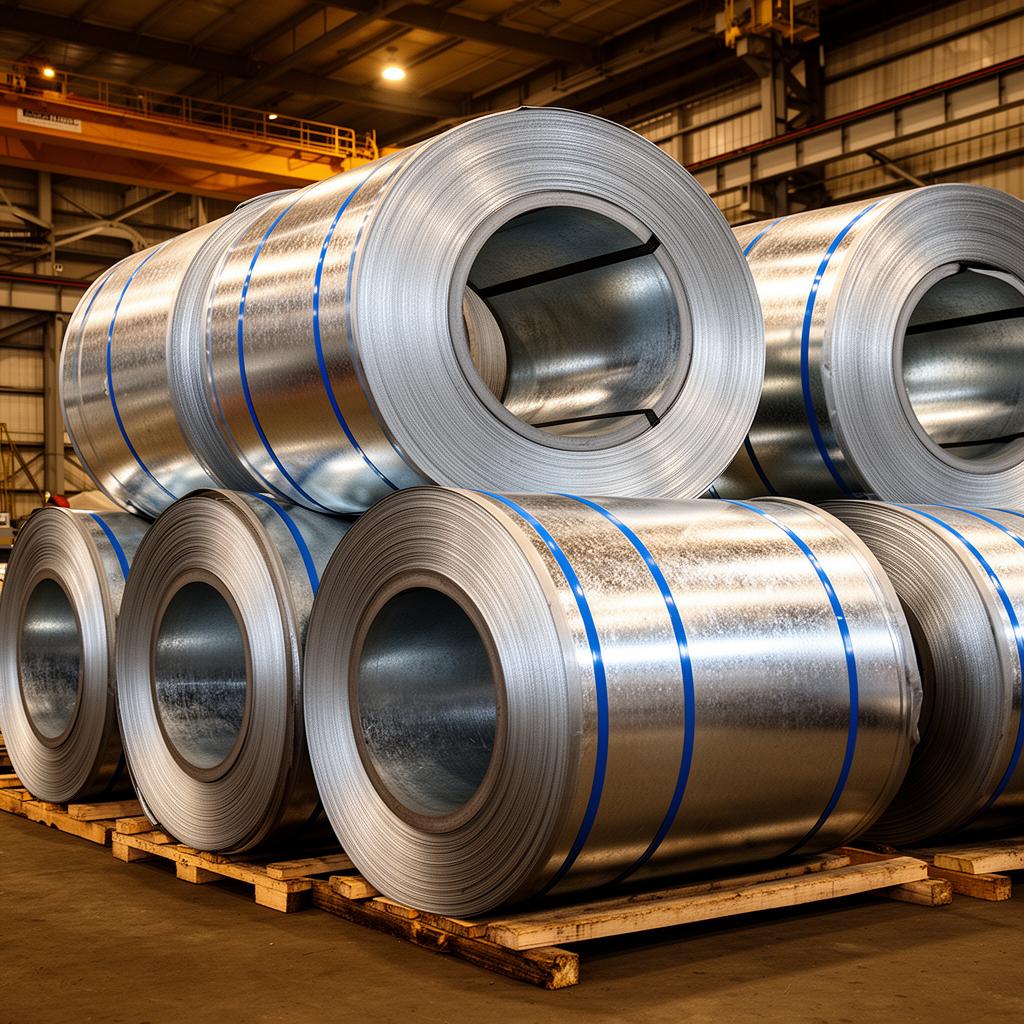
Galvanized Iron (GI) Coils are the workhorse of modern construction and HVAC across the GCC. Behind every silver-spangled coil is a precisely controlled continuous hot-dip galvanizing (CGL) line, where cold-rolled steel passes through a sequence of cleaning, annealing, zinc immersion and cooling stages — all in a single uninterrupted strip moving at speeds of up to 180 metres per minute.
1. Feedstock: Cold-Rolled Full-Hard Coils
The process begins with full-hard cold-rolled steel coils, typically 0.12 mm to 4.0 mm thick. Two incoming coils are welded end-to-end on an entry accumulator so that the strip can run continuously without ever stopping the galvanizing line.
2. Alkaline Cleaning & Brushing
Cold-rolled strip arrives coated with rolling oil and iron fines. The strip is sprayed with hot alkaline cleaner (typically 60–80 °C), scrubbed with rotating brush rolls, electrolytically cleaned, then rinsed and dried. A perfectly clean surface is essential — any oil residue prevents the zinc from metallurgically bonding to the steel.
3. Continuous Annealing in a Reducing Atmosphere
The cleaned strip enters a long vertical furnace running on a hydrogen–nitrogen (HNX) atmosphere. The steel is heated to 700–850 °C to:
- Soften the cold-worked microstructure (recrystallization annealing)
- Reduce any residual surface iron oxide back to pure iron
- Develop the mechanical properties required by the target grade (DX51D, S280GD, etc.)
4. Controlled Cooling to Zinc Bath Temperature
Before entering the molten zinc, the strip is cooled in the same protective atmosphere down to roughly 460 °C — just above the zinc bath temperature. This is critical: if the strip is too hot it disturbs the bath chemistry; too cold and the zinc will not wet the surface evenly.
5. Immersion in the Molten Zinc Bath
The strip dives into a bath of molten zinc held at around 455–465 °C. A small percentage of aluminium (0.15–0.30%) is added to the zinc to form an Fe–Al inhibition layer that controls the growth of brittle iron–zinc intermetallics and produces a ductile, formable coating. The strip is guided around a sink roll and exits the bath vertically.
6. Air Knives: Coating Weight Control
As the strip emerges from the zinc, high-pressure air or nitrogen knives wipe excess molten zinc back into the bath. By adjusting knife pressure, height, and strip speed, the operator dials in the coating weight — anywhere from Z60 (60 g/m² total, both sides) up to Z275 (275 g/m²) or heavier for marine applications.
7. Cooling Tower & Spangle Development
Above the air knives the zinc solidifies as it cools. The cooling rate and bath chemistry determine whether the coil develops a regular spangle (large, visible crystals), a minimized spangle (small, uniform pattern preferred for paint substrate) or a zero-spangle finish.
8. Skin Pass, Tension Levelling & Chromate Passivation
The cooled strip is given a light skin-pass rolling to flatten the surface and lock in mechanical properties, then tension-levelled for strip flatness. Finally a chromate-free passivation and/or oil film is applied to prevent wet-storage stains during shipping and stocking.
9. Recoiling, Weighing & Inspection
The continuous strip is sheared and recoiled into finished GI Coils of 3–12 MT. Every coil is weighed, edge-trimmed if specified, banded, and given a unique heat/coil number that ties back to the mill test certificate (MTC) — coating weight, mechanical properties, chemistry, and dimensional data.
Why the Process Matters for Specifiers
Every parameter — bath aluminium content, strip temperature, air-knife pressure, cooling profile — directly affects how the coating performs in the field. Saffron Steel sources GI Coils only from mills that operate fully instrumented CGL lines and supply complete MTCs traceable to ASTM A653, EN 10346 or JIS G3302, so what you specify is what arrives on site.
Galvanized Coils (GI Coils)
Hot-dipped galvanized coils with superior corrosion resistance.