Deformed Rebar: From Billet to Bundle
How rebar mills hot-roll billets into the deformed, high-yield reinforcement bars that hold every concrete structure together.
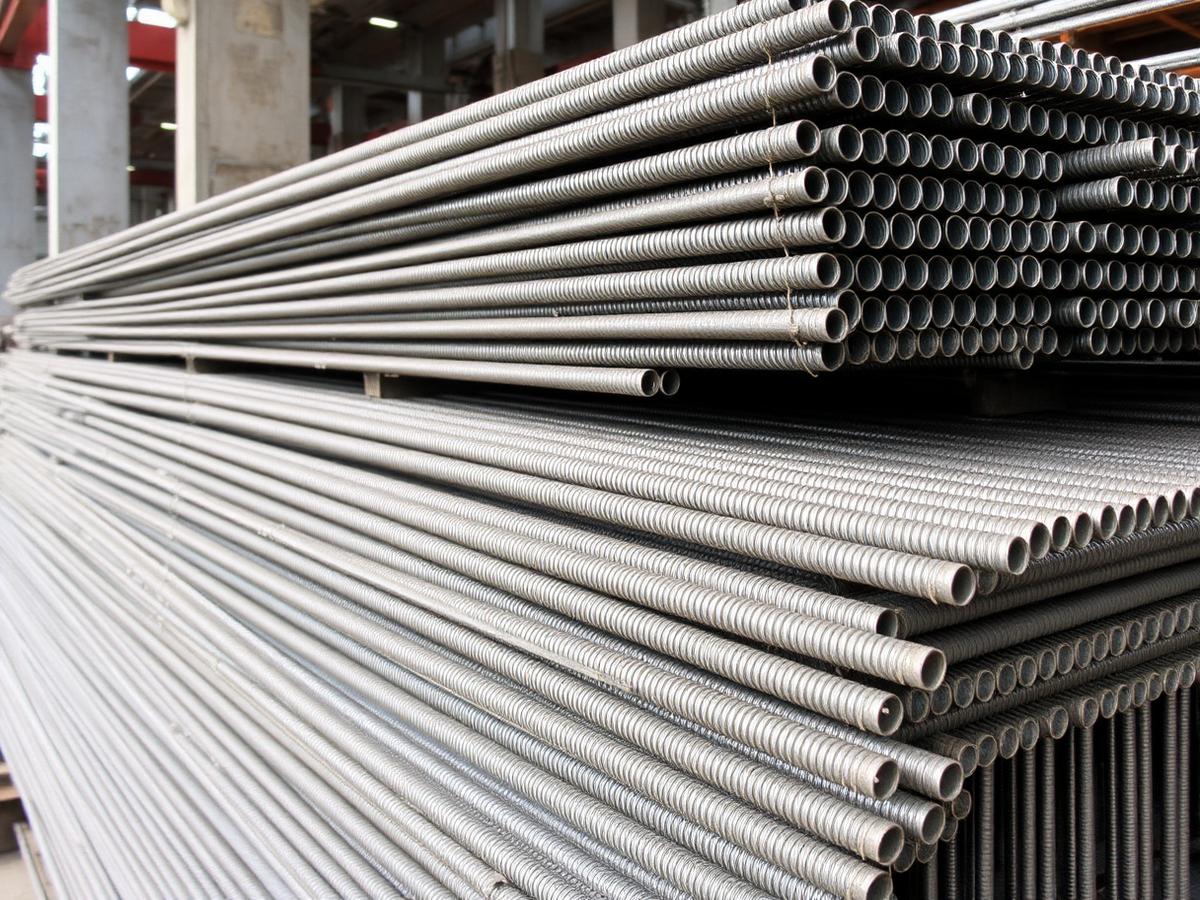
Deformed rebar is produced on long-product rolling mills that take square billets and reduce them through a series of grooved rolls into round bars with characteristic ribs that mechanically lock into concrete.
1. Billet Production
Continuously cast billets — typically 130×130 mm or 150×150 mm — are produced from EAF or BOF steel. Chemistry is tightly controlled for carbon equivalent (weldability) and microalloying (V, Nb) when high-strength grades are required.
2. Reheating Furnace
Billets are reheated to 1100–1180 °C in pusher-type or walking-beam furnaces and conveyed to the roughing mill.
3. Roughing, Intermediate & Finishing Stands
The billet passes through 16–22 stands in succession. Each stand has shaped grooves that progressively reduce cross-section and impart the diameter. The final stand is the rib-forming pass — a precisely engraved roll cuts the longitudinal and transverse rib pattern unique to that mill (used for traceability).
4. Quench & Self-Tempering (QST / Tempcore)
Immediately after the finishing stand, the bar passes through high-pressure water boxes. The surface quenches to martensite while the core stays hot; the heat then flows outwards and self-tempers the martensitic case. The result is high yield strength (B500B, Gr 60+) with excellent ductility and weldability — without expensive alloy.
5. Cooling Bed, Cut-to-Length & Bundling
Bars are deposited on a walking cooling bed where they air-cool while moving sideways. Once cool they are sheared to 6 m or 12 m, counted and tied into bundles of ~2 MT, tagged with full traceability to the heat number.
Deformed Rebar
High-tensile reinforcement bars for concrete construction.