Strategic GI Coil Supplier Selection for Infrastructure
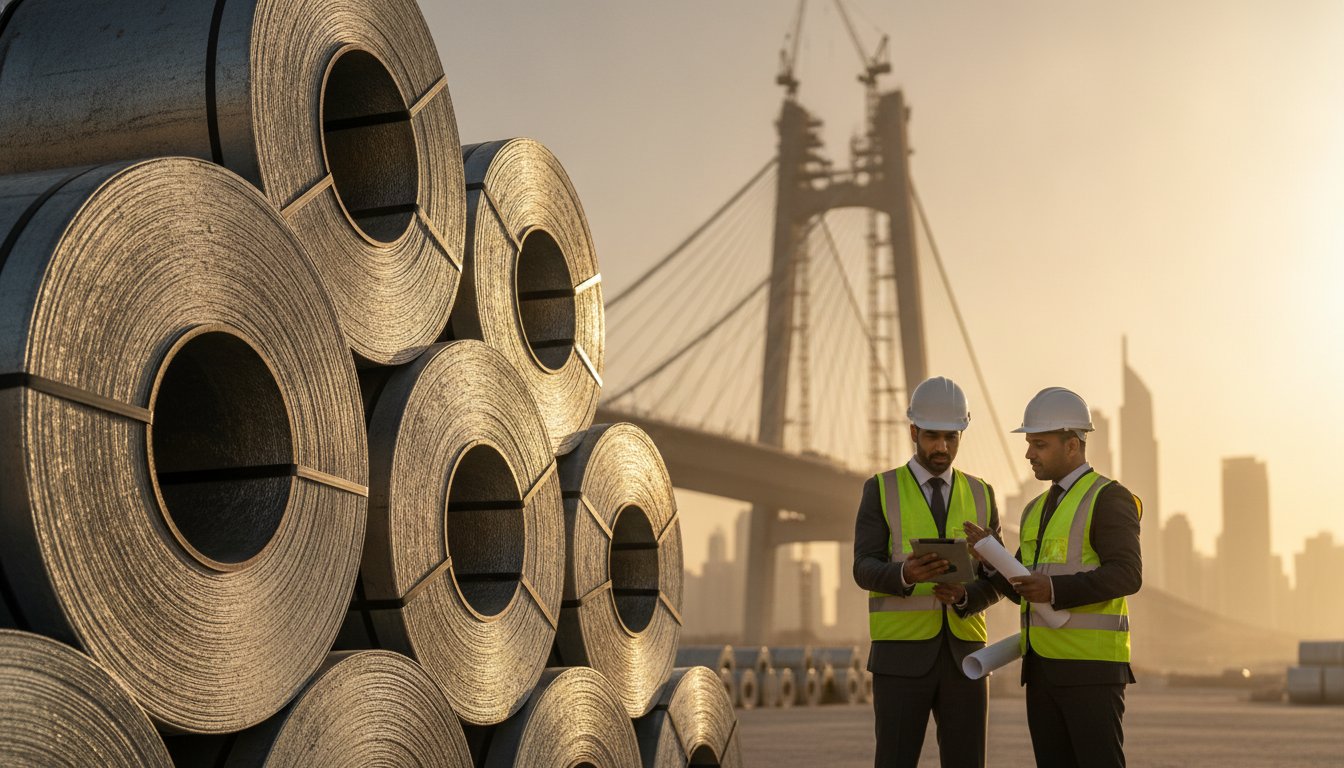
A single ton of sub-standard galvanized steel can compromise a multi-million dirham infrastructure project before the first structural beam is even set. In a market where global steel demand is projected to reach 1,773 million tonnes by the end of 2026, the pressure to secure volume often leads to overlooked technical specifications. Procurement professionals understand that a low per-ton price is irrelevant if your GI coil supplier provides material that fails to withstand the UAE's high-salinity environments or arrives weeks behind schedule.
Selecting a reliable partner requires more than a simple price comparison; it demands a rigorous audit of global sourcing networks and mill certifications. This article provides the strategic criteria necessary to verify ASTM and EN compliance while optimizing your procurement costs through wholesale distribution. You'll learn how to navigate current supply chain volatility and secure high-performance materials that guarantee long-term corrosion resistance for large-scale industrial and marine applications.
Key Takeaways
- Differentiate between cold-rolled and hot-rolled bases to select the appropriate strength and finish for specific structural applications.
- Master the technical nuances between ASTM A653 and EN 10346 standards to ensure full compliance with UAE building regulations.
- Evaluate how a strategic GI coil supplier utilizes global mill networks to mitigate supply volatility and stabilize project budgets.
- Implement a strict Mill Test Certificate (MTC) verification protocol to confirm chemical analysis and ensure long-term corrosion resistance.
- Optimize procurement logistics by leveraging wholesale distribution models designed for large-scale industrial and marine infrastructure.
Technical Fundamentals of Galvanized Steel Coils
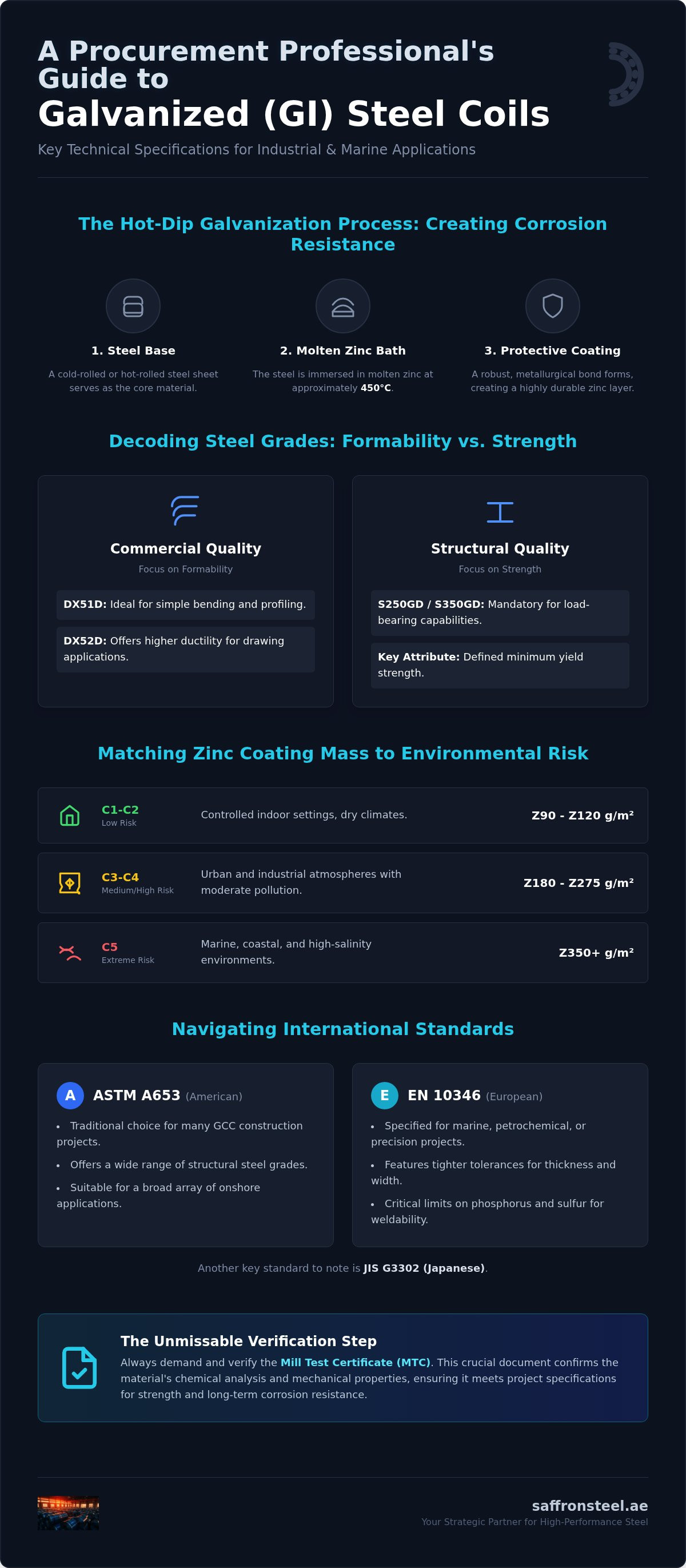
Galvanized Iron (GI) coils serve as the primary material for durable industrial infrastructure across the GCC. These products consist of cold-rolled or hot-rolled steel sheets that undergo a specialized metallurgical treatment to receive a protective zinc layer. This process, specifically hot-dip galvanization, involves immersing the steel in a molten zinc bath at temperatures near 450°C. This creates a robust bond that prevents oxidation and physical wear. For a detailed Technical overview of galvanization, engineers often examine the chemical reaction that forms protective alloy layers. In the UAE's demanding climate, selecting a qualified GI coil supplier is the first step in ensuring that the base material can withstand high humidity and saline exposure.
The applications for these coils are extensive. They are vital in construction for roofing and wall cladding, in HVAC systems for ductwork, and within the automotive sector for corrosion-resistant body parts. It's a fundamental engineering principle that the service life of the material is directly proportional to the mass of the zinc coating applied to the steel surface.
Understanding Steel Grades and Specifications
Choosing the correct grade is essential for structural integrity and project compliance. Common designations include DX51D, which is a commercial quality grade suitable for simple bending and profiling. DX52D offers higher ductility for drawing applications. For projects requiring load-bearing capabilities, structural grades like S250GD or S350GD are mandatory. Structural quality steel possesses defined minimum yield strengths, whereas commercial quality focuses on formability. A methodical GI coil supplier helps match these mechanical properties to your specific engineering requirements to avoid structural fatigue.
The Role of Zinc Coating Mass
The zinc coating mass, measured in grams per square meter (g/m²), dictates the material's environmental resilience. Designations typically range from Z90 for indoor or mild environments to Z350 for heavy industrial use. Matching the coating to the environment is a precision task:
- C1 to C2: Low risk environments, suitable for Z90 to Z120 coatings in controlled indoor settings.
- C3 to C4: Medium to high risk, requiring Z180 to Z275 for urban and industrial atmospheres.
- C5: Extreme risk, necessitating Z350 or specialized alloys for marine and coastal infrastructure.
Consistency in coating thickness is vital for performance. Non-uniform application leads to premature localized failure, which can jeopardize the entire project’s longevity. Precision in sourcing ensures that every coil meets these strict uniformity standards.
International Standards for GI Coil Compliance
Compliance with global quality benchmarks is the cornerstone of structural reliability in the UAE's infrastructure and energy sectors. Large-scale projects, particularly in oil and gas, demand materials that meet rigorous mechanical and chemical specifications. Navigating these requirements requires a GI coil supplier with deep technical expertise in the three primary international standards: ASTM A653 (American), EN 10346 (European), and JIS G3302 (Japanese). These frameworks ensure that the steel possesses the necessary tensile strength and elongation properties to survive heavy fabrication and long-term environmental stress. Adhering to International Galvanizing Standards ensures that every ton of steel delivered to a site performs exactly as the engineering team intended.
ASTM A653 vs. EN 10346: Key Differences
While both standards define high-quality galvanized products, they differ in chemical composition and dimensional tolerances. ASTM A653 is the traditional choice for many onshore construction projects in the GCC, offering a wide range of structural steel grades. In contrast, EN 10346 often features tighter tolerances for thickness and width, which is vital for precision engineering. European standards are frequently specified for marine environments or petrochemical facilities where specific phosphorus and sulfur limits are critical for weldability. Choosing between them depends on whether the project follows American or European design codes.
Surface Finishes and Spangle Requirements
The visual and functional characteristics of a GI coil are defined by its spangle, the visible zinc crystals on the surface. Procurement professionals can choose from several options:
- Regular Spangle: The traditional multi-faceted zinc pattern, suitable for hidden structural components.
- Minimized Spangle: Smaller, less visible crystals that provide a more uniform surface.
- Zero Spangle: A smooth, matte finish achieved through specialized cooling, ideal for high-end powder coating or aesthetic cladding.
Surface treatments also play a strategic role in material longevity. Chromated (passivated) coils resist "white rust" during sea transit, while oiled surfaces provide temporary protection during storage. For projects requiring specific compliance documentation and finish selection, consulting with an expert in structural steel sourcing is recommended to ensure the material matches the final application perfectly.
A reliable GI coil supplier will provide a Mill Test Certificate (MTC) that confirms the material's adherence to these standards. This documentation verifies that the steel's chemical analysis and physical testing results align with the specified ASTM, EN, or JIS requirements. Without this verification, the risk of material failure in the harsh Middle Eastern climate increases significantly.
Evaluating a GI Coil Supplier: Sourcing and Reliability
A GI coil supplier’s reliability is fundamentally linked to the breadth of their sourcing network. In the UAE, where infrastructure demand is constant, relying on a single region for steel can introduce significant project risks. A methodical manager of global supply chains looks beyond local availability to secure materials from Europe, Asia, and the MENA region. This strategy ensures that high-level expertise in ASTM and EN standards is matched with consistent volume, regardless of regional market shifts. Selecting a GI coil supplier with established wholesale distribution capabilities ensures that logistical hurdles don't affect the project timeline or the bottom line.
Global Sourcing Strategy: Europe vs. Asia
The choice between sourcing regions involves a strategic analysis of technical requirements and budget constraints. European mills are the benchmark for high-specification structural grades. They offer stringent EN compliance that is often preferred for critical marine or oil and gas infrastructure. Conversely, Asian mills provide high-volume availability for commercial grades at competitive price points. While some international markets follow strict Federal Steel Sourcing Requirements to prioritize domestic production, the GCC market benefits from a more open, diversified approach. MENA-based mills offer the advantage of proximity, reducing transit times for urgent structural requirements. By maintaining relationships across multiple continents, a supplier can mitigate supply chain disruptions caused by regional tariffs or production slowdowns.
Logistical Excellence in National Distribution
Material quality is only half of the procurement equation. Logistical precision ensures that the GI coils arrive at the site in pristine condition and on schedule. Specialized storage is critical for galvanized products; improper climate control can lead to "white rust" or wet storage stain, which compromises the zinc coating discussed in previous sections. Professional management involves more than just transport; it requires a deep understanding of the heavy-duty nature of the industry. Reliable distribution includes:
- Monitoring delivery timelines to align with strict project phases to prevent costly delays.
- Implementing rigorous quality control during the transit and handling of bulk steel.
- Providing custom sourcing for unique structural steel requirements that standard inventories might not cover.
For large-scale projects, the ability to handle complex B2B logistics is a non-negotiable trait. A supplier must operate like a well-oiled machine, ensuring that every shipment is documented and every deadline is met with industrial precision. This level of organization provides the security and confidence that procurement professionals require for multi-year infrastructure developments.
Strategic Procurement Checklist and Quality Verification
A systematic audit of technical documentation is the most effective way to mitigate risk in large-scale steel procurement. The Mill Test Certificate (MTC) acts as the definitive record of a material’s chemical and mechanical properties. It ensures that the steel delivered to the site aligns perfectly with the engineering specifications established during the design phase. MTCs serve as the primary legal instrument for establishing material accountability and tracing liability in the event of structural failure within high-stakes infrastructure projects. When you partner with a professional GI coil supplier, they should provide these documents transparently for every batch, allowing for full traceability from the mill to the project site.
Decoding the Mill Test Certificate (MTC)
Verification begins with confirming the certificate’s compliance with international standards like EN 10204. A type 3.1 certificate is issued by the manufacturer’s authorized inspection representative, while a type 3.2 certificate requires an independent third-party inspector. Procurement teams must cross-reference the heat number on the certificate with the physical tags on the coils. This heat number identifies the specific batch of molten steel, linking it to its chemical analysis, including carbon, manganese, and phosphorus levels. Red flags in documentation include inconsistent fonts, missing stamps, or mechanical test results that sit exactly on the minimum threshold without any variance. These discrepancies often indicate a need for secondary lab testing to verify the material's integrity.
On-Site Quality Inspection Protocols
Physical inspection upon delivery is the final safeguard against material degradation or logistical errors. While the MTC provides the theoretical data, on-site checks confirm the material's current state. Inspectors should prioritize the following 5-point checklist:
- Heat Number Verification: Confirm that the physical coil tags match the provided MTC documentation exactly.
- Dimensional Accuracy: Measure the actual gauge and width using calibrated micrometers to ensure they fall within nominal thickness tolerances.
- Surface Integrity: Conduct a visual sweep for edge waves, physical dents, or signs of white rust caused by moisture during transit.
- Coating Uniformity: Check for a consistent spangle and finish, ensuring no localized thinning of the zinc layer is visible.
- Mechanical Ductility: Perform simple bend tests on sample strips if the application requires intensive fabrication or roll-forming.
Adhering to these protocols prevents the integration of sub-standard steel into the project, which could lead to premature corrosion or structural fatigue. For high-volume requirements, it's vital to consult with a strategic GI coil supplier that understands the nuances of GCC quality standards and provides comprehensive documentation as a standard operational procedure. This methodical approach to quality verification ensures that every dirham spent contributes to the long-term durability of the infrastructure.
Saffron Steel: Your Strategic Partner for GI Coil Supply
Saffron Steel LLC operates as a specialized wholesale distributor, providing the industrial backbone for the UAE's most ambitious infrastructure developments. Unlike localized manufacturers limited by internal production capacities, we function as a methodical manager of global supply chains. Our inventory includes a comprehensive range of flat and long steel products, including GI Coils, Cold Rolled Coils, and Hot Rolled Coils, alongside essential structural components like H Beams and Deformed Rebar. By positioning ourselves as a versatile GI coil supplier, we ensure that procurement professionals have access to a diversified inventory that meets both commercial and structural quality requirements.
Our commitment to industrial precision is reflected in our rigorous quality control protocols and adherence to international standards. We leverage an extensive network of mills across Europe, Asia, and the MENA region to secure competitive pricing and material variety that single-source providers cannot match. This global reach allows us to stabilize supply for our partners, even during periods of market volatility or regional production shifts. Our professional team brings decades of collective expertise to the national steel market, offering technical guidance that extends far beyond simple transactional sales.
Tailored Sourcing for Industrial and Marine Projects
Large-scale projects in the oil and gas and marine sectors require materials that can withstand extreme environmental stressors. We specialize in supplying GI coils that meet the high-spec requirements of these demanding industries, ensuring that every batch complies with the specific ASTM or EN grades dictated by project engineers. Our custom sourcing capabilities mean we can procure specific structural steel profiles and international grades that are often unavailable through standard retail channels. We prioritize long-term partnerships, built on a foundation of transparent procurement processes and meticulous documentation, including the verification of Mill Test Certificates for every shipment.
Streamlined Logistics and GCC-Wide Reach
Managing the movement of bulk steel requires a sophisticated logistical framework to maintain material integrity. We oversee the entire distribution process, ensuring that GI coils are stored and transported under conditions that prevent physical damage or chemical oxidation. Our GCC-wide reach ensures that infrastructure projects receive their materials on schedule, regardless of the project's scale or location. We understand that in the heavy-duty industrial sector, a delay in delivery is a delay in progress. By maintaining a well-oiled logistics machine, we provide the security and confidence necessary for complex project management. Consult with Saffron Steel LLC for your wholesale GI coil requirements to secure a dependable partner for your next industrial development.
Securing Structural Longevity through Precision Procurement
Selecting the right GI coil supplier for large-scale infrastructure requires a methodical approach that balances technical standards with logistical excellence. Moving beyond simple price-per-ton metrics allows procurement professionals to prioritize ASTM and EN compliance; this ensures the structural integrity of marine and industrial projects. By implementing the rigorous Mill Test Certificate verification protocols discussed, you can effectively mitigate the risks of material degradation and project delays. Saffron Steel supports these strategic objectives by sourcing high-performance materials from leading European and Asian mills, ensuring that every ton delivered meets the most stringent quality benchmarks.
Our focus on precision and reliable national distribution provides the security needed for complex developments across the UAE. We invite you to Request a Bulk Quote for GI Coils from Saffron Steel to streamline your supply chain and secure the structural longevity of your next development. With a strategic partner dedicated to industrial precision, your projects are built to withstand the most demanding environmental stressors. Let's work together to ensure your procurement process is as robust as the steel we deliver.
Frequently Asked Questions
What is the standard thickness for GI coils in industrial applications?
The standard thickness for GI coils in industrial applications typically ranges from 0.5mm to 2.0mm, though specialized projects may require gauges as thin as 0.12mm or as thick as 4.0mm. For structural cladding and roofing in the UAE, 0.7mm and 0.9mm are frequently specified. Selecting the correct gauge is vital for meeting load-bearing requirements. A professional GI coil supplier can provide specific thickness tolerances that align with your engineering blueprints.
How do I calculate the weight of a galvanized steel coil?
To calculate the weight of a galvanized steel coil, use the formula: Weight (kg) = Thickness (mm) x Width (mm) x Length (m) x 0.00785. You must also account for the zinc coating mass, usually ranging from Z90 to Z350 g/m². For example, a coil with a 1.0mm thickness and 1219mm width has a theoretical weight of approximately 9.57 kg per linear meter. Precise weight calculations are essential for logistical planning and freight cost optimization.
What is the difference between hot-dip galvanized and electro-galvanized coils?
Hot-dip galvanized coils are submerged in molten zinc, creating a thick, multi-layered alloy that provides superior corrosion resistance for outdoor infrastructure. Electro-galvanized coils use an electrolytic process to apply a thinner, more uniform zinc layer, which is ideal for indoor appliances or automotive parts requiring a smooth finish. For large-scale industrial projects in the Middle East, hot-dip galvanization is the preferred choice due to its ability to survive harsh environmental conditions and high humidity levels.
How can I prevent white rust during the storage of GI coils?
Preventing white rust requires maintaining a dry, well-ventilated storage environment with stable temperatures to avoid condensation. Coils should be stored off the ground on pallets and covered with waterproof but breathable materials. If moisture is trapped between the tightly wound layers, the zinc reacts to form zinc hydroxide. Sourcing from a reputable GI coil supplier ensures your material arrives with proper passivation or oiling treatments designed to resist oxidation during transit and warehouse storage.
Is ASTM A653 equivalent to EN 10346?
ASTM A653 and EN 10346 are comparable international standards but are not strictly identical. ASTM A653 is the American standard often used for onshore GCC projects, while EN 10346 is the European equivalent frequently specified for marine and petrochemical infrastructure. While they cover similar products, they differ in specific chemical composition limits and mechanical property thresholds. Engineers must verify which standard is cited in the project’s technical specifications to ensure full regulatory compliance.
What information should be present on a Mill Test Certificate (MTC)?
A comprehensive Mill Test Certificate (MTC) must include the unique heat number, chemical analysis (carbon, manganese, phosphorus, and sulfur content), and mechanical test results such as yield strength, tensile strength, and elongation. It should also specify the zinc coating mass, material dimensions, and the specific standard of compliance, such as EN 10204 3.1. Verification of this data ensures that the steel meets the safety and performance criteria required for high-liability industrial applications.
Can GI coils be used in high-salinity marine environments?
GI coils are suitable for high-salinity marine environments provided they feature a high zinc coating mass, typically Z275 or Z350. In extreme coastal conditions, standard galvanization may require additional protective coatings or the use of specialized alloys like Galvalume for extended service life. Your supplier can advise on the appropriate coating thickness to ensure the material resists the accelerated corrosion rates common in the UAE's coastal and offshore infrastructure projects.
Frequently Asked Questions
The standard thickness for GI coils in industrial applications typically ranges from 0.5mm to 2.0mm, though specialized projects may require gauges as thin as 0.12mm or as thick as 4.0mm. For structural cladding and roofing in the UAE, 0.7mm and 0.9mm are frequently specified. Selecting the correct gauge is vital for meeting load-bearing requirements. A professional GI coil supplier can provide specific thickness tolerances that align with your engineering blueprints.
To calculate the weight of a galvanized steel coil, use the formula: Weight (kg) = Thickness (mm) x Width (mm) x Length (m) x 0.00785. You must also account for the zinc coating mass, usually ranging from Z90 to Z350 g/m². For example, a coil with a 1.0mm thickness and 1219mm width has a theoretical weight of approximately 9.57 kg per linear meter. Precise weight calculations are essential for logistical planning and freight cost optimization.
Hot-dip galvanized coils are submerged in molten zinc, creating a thick, multi-layered alloy that provides superior corrosion resistance for outdoor infrastructure. Electro-galvanized coils use an electrolytic process to apply a thinner, more uniform zinc layer, which is ideal for indoor appliances or automotive parts requiring a smooth finish. For large-scale industrial projects in the Middle East, hot-dip galvanization is the preferred choice due to its ability to survive harsh environmental conditions and high humidity levels.
Preventing white rust requires maintaining a dry, well-ventilated storage environment with stable temperatures to avoid condensation. Coils should be stored off the ground on pallets and covered with waterproof but breathable materials. If moisture is trapped between the tightly wound layers, the zinc reacts to form zinc hydroxide. Sourcing from a reputable GI coil supplier ensures your material arrives with proper passivation or oiling treatments designed to resist oxidation during transit and warehouse storage.
ASTM A653 and EN 10346 are comparable international standards but are not strictly identical. ASTM A653 is the American standard often used for onshore GCC projects, while EN 10346 is the European equivalent frequently specified for marine and petrochemical infrastructure. While they cover similar products, they differ in specific chemical composition limits and mechanical property thresholds. Engineers must verify which standard is cited in the project’s technical specifications to ensure full regulatory compliance.
A comprehensive Mill Test Certificate (MTC) must include the unique heat number, chemical analysis (carbon, manganese, phosphorus, and sulfur content), and mechanical test results such as yield strength, tensile strength, and elongation. It should also specify the zinc coating mass, material dimensions, and the specific standard of compliance, such as EN 10204 3.1. Verification of this data ensures that the steel meets the safety and performance criteria required for high-liability industrial applications.
GI coils are suitable for high-salinity marine environments provided they feature a high zinc coating mass, typically Z275 or Z350. In extreme coastal conditions, standard galvanization may require additional protective coatings or the use of specialized alloys like Galvalume for extended service life. Your supplier can advise on the appropriate coating thickness to ensure the material resists the accelerated corrosion rates common in the UAE's coastal and offshore infrastructure projects.