The Strategic Checklist for Bulk Steel Procurement in 2026

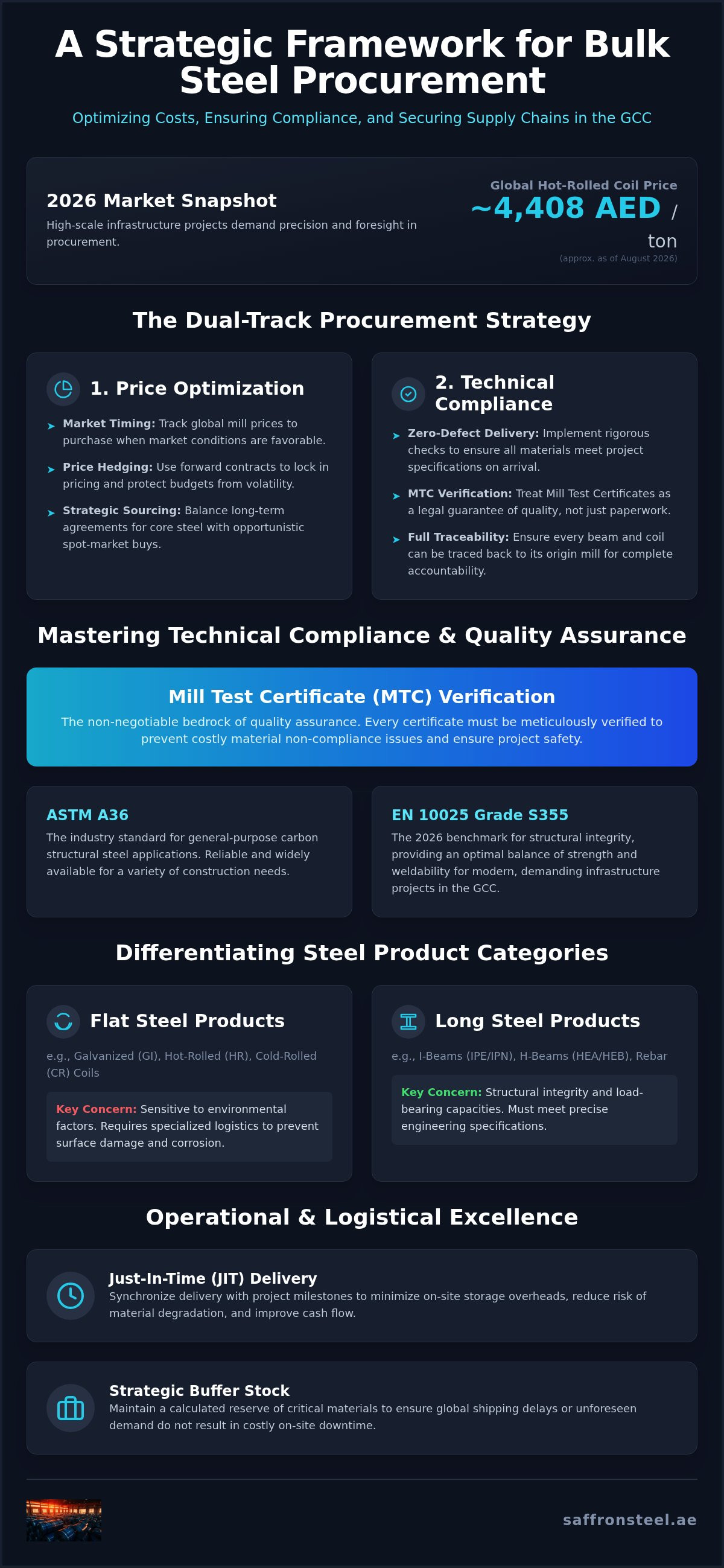
Can a single discrepancy in a Mill Test Certificate (MTC) justify the risk of halting a multi-million Dirham infrastructure project? In a market where global hot-rolled coil prices have reached approximately 4,408 AED per ton as of August 2026, the margin for error in bulk steel procurement has effectively vanished. You're likely facing the relentless pressure of price volatility and the logistical complexities of ensuring that every I-beam or galvanized coil arrives exactly when and where it's needed. We understand that managing these variables requires more than just a list of suppliers; it requires a rigorous, methodical approach to risk mitigation.
This article provides a comprehensive framework designed for procurement professionals to optimize costs, ensure strict technical compliance, and eliminate the bottlenecks common in large-scale steel orders. We'll examine a strategic checklist that moves from global sourcing at the mill level to final-mile delivery across the GCC to ensure zero-defect material delivery and full traceability. By following this structured guide, you'll gain the tools necessary to maintain predictable pricing and secure your supply chain against regional logistical delays.
Key Takeaways
- Learn how to navigate the 2026 market by integrating a dual-track strategy for bulk steel procurement that balances price optimization with rigorous technical compliance.
- Master the Mill Test Certificate (MTC) verification process to ensure zero-defect material delivery and full traceability for structural beams and specialized coils.
- Understand the critical differences between ASTM and EN standards to select the most resilient specifications for the unique environmental conditions of the UAE and GCC.
- Discover how to synchronize Just-In-Time (JIT) delivery schedules with project milestones to minimize storage overheads and prevent material degradation.
- Identify the strategic advantages of utilizing a single-source distribution partner for comprehensive inventory management, from HEA/HEB beams to galvanized coils.
The Foundation of Strategic Bulk Steel Procurement
In 2026, industrial demand across the GCC is characterized by high-scale infrastructure projects that leave little room for supply chain inefficiency. Strategic bulk steel procurement has evolved beyond simple volume purchasing; it's now a sophisticated procurement process that integrates technical precision with financial foresight. For a project to remain viable, procurement professionals must move away from reactive buying and toward a framework that anticipates market shifts and technical requirements months in advance.
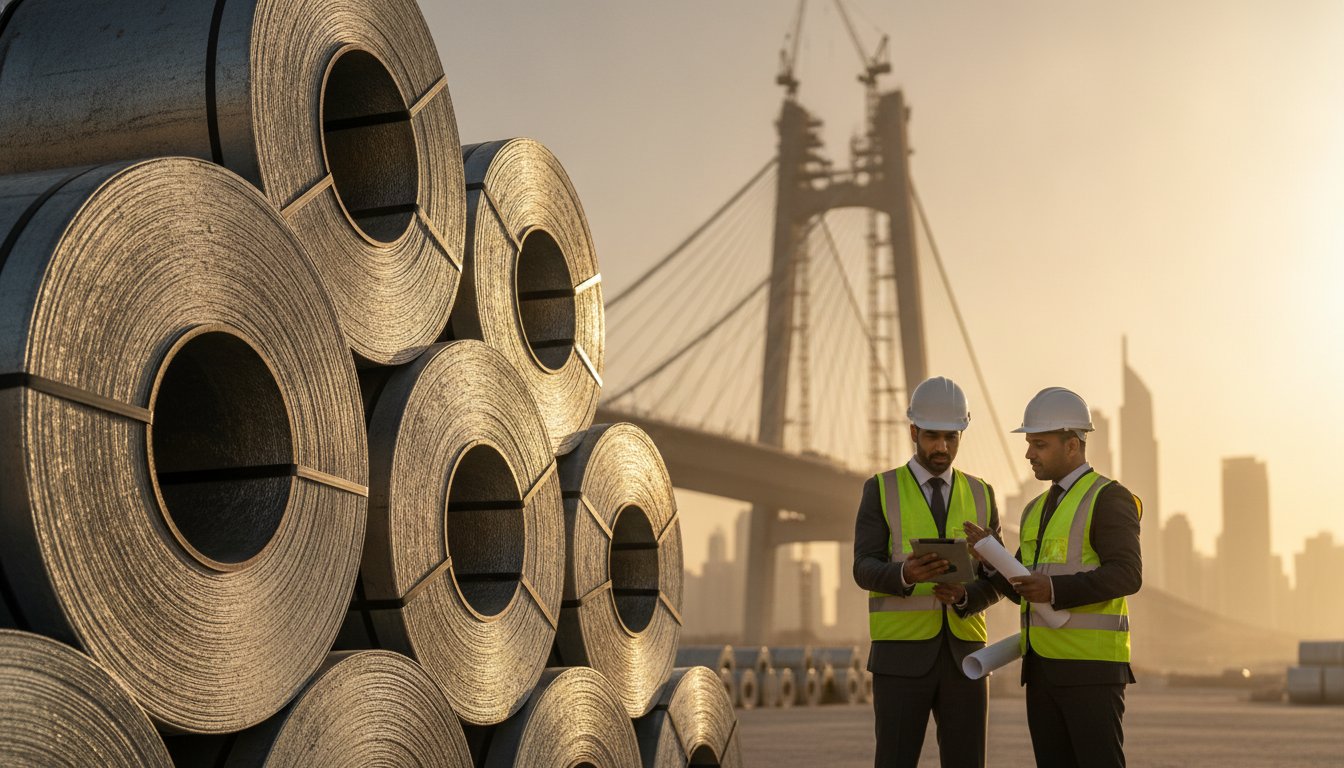
A fundamental step in this strategy is distinguishing between the procurement needs of flat steel and long steel. Flat products, such as Galvanized Coils (GI), Hot Rolled (HR), and Cold Rolled (CR) coils, are often sensitive to environmental factors and require specialized logistics to prevent surface damage. In contrast, long steel products like I-beams (IPE/IPN), H-beams (HEA/HEB), and deformed rebar focus on structural integrity and load-bearing capacities. Treating these categories as a single commodity often leads to logistical oversights that can stall a project. A standardized checklist is the only reliable method to manage these multi-tonnage risks, ensuring that every component meets the specific demands of the build.
The financial impact of bulk purchasing on project ROI is substantial. While the initial commitment of capital is significant, the per-unit savings and the ability to bypass mid-project price spikes protect the overall cash flow. In the UAE market, where project budgets are often calculated in the millions of Dirhams (AED), even a minor percentage reduction in procurement costs can translate into massive savings for the stakeholder. Secure sourcing ensures that the capital remains productive rather than being tied up in resolving material non-compliance issues.
Identifying Project-Wide Material Requirements
Successful procurement starts with a detailed analysis of total tonnage compared against phased delivery schedules. You shouldn't order your entire steel requirement for a three-year project at once. Instead, categorize needs by phase. Structural frames requiring HEA or HEB beams must be prioritized in the early stages, while corrosive-resistant GI coils for secondary components can be scheduled for later arrival. It's also vital to determine a "buffer stock" for critical infrastructure phases. Having a reserve of essential materials ensures that global shipping delays don't result in expensive downtime on-site.
Market Timing and Price Hedging Strategies
Tracking global mill price trends for HR and GI coils allows procurement teams to strike when the market is favorable. In 2026, forward contracts have become an essential tool for stabilizing bulk procurement budgets. These agreements allow you to lock in pricing for large-scale orders, protecting the project from the volatility of the spot market. A sophisticated strategy involves balancing these long-term agreements for core structural steel with opportunistic spot-market purchases for supplementary items like steel angles, pipes, or tubes when local inventory levels are high.
Technical Compliance and Quality Assurance Checklist
Technical compliance is the bedrock of any successful bulk steel procurement strategy. In the UAE, where extreme temperatures and high salinity levels are standard, selecting the wrong material specification can lead to structural failure or rapid corrosion. Procurement teams must move beyond price-centric models and adopt a rigorous technical validation process that begins at the mill and ends at the final delivery point.
Standardizing Specifications: ASTM A36, EN 10025, and Beyond
Matching steel grades to specific industrial applications is critical for long-term project safety. While ASTM A36 remains the standard for general carbon steel applications, marine and offshore projects in the GCC often demand higher corrosion resistance and yield strengths. Monitoring international production trends through the Global Steel Trade Monitor allows procurement managers to verify that their chosen mills are capable of meeting these precise chemical and mechanical requirements. EN 10025 Grade S355 is the benchmark for structural integrity in 2026. This grade provides the optimal balance of weldability and strength required for modern infrastructure.
MTC Verification and Material Traceability
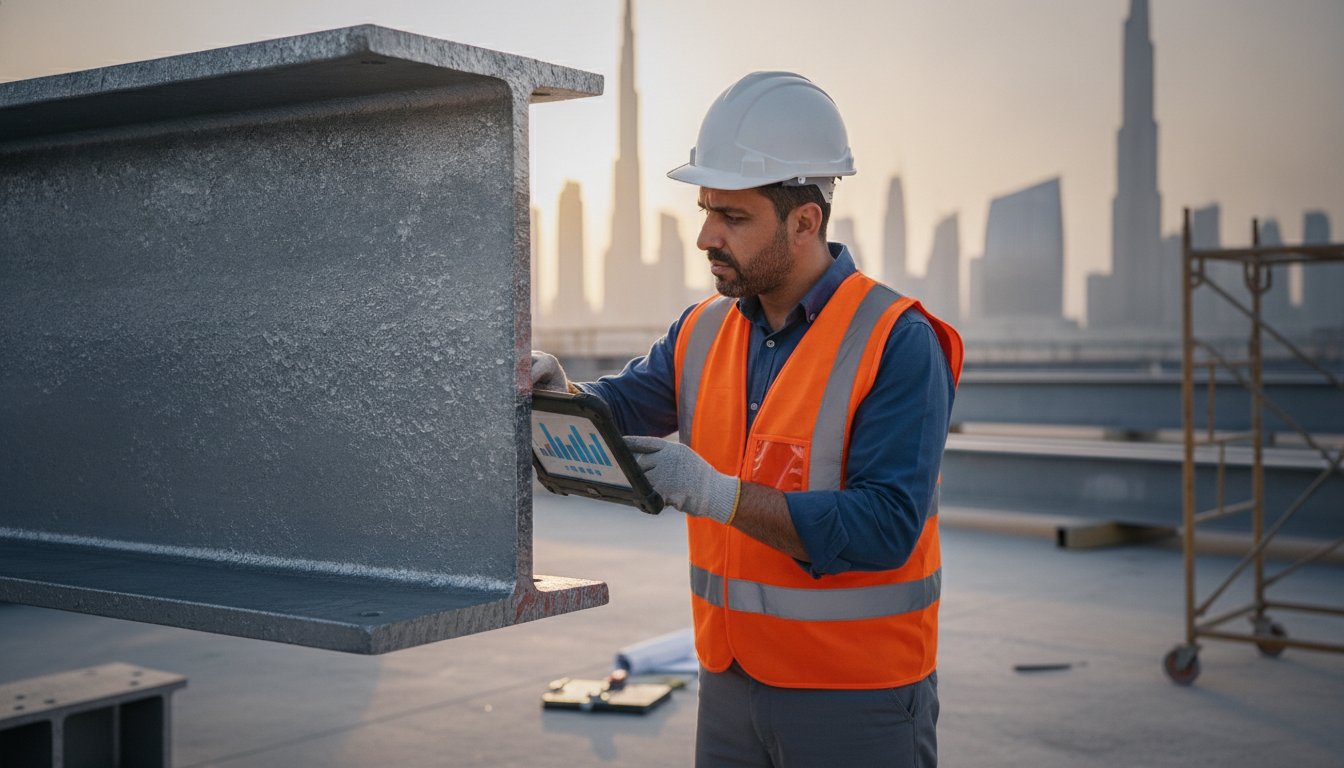
A Mill Test Certificate (MTC) isn't just paperwork; it's a legal guarantee of quality. Every bulk order of GI coils, HEA/HEB beams, or pipes must be accompanied by an MTC that highlights the chemical composition and mechanical properties of the steel. You must verify that the heat number stamped on the physical material matches the heat number on the certificate. This correlation ensures that the steel you've purchased is the exact material tested at the mill, preventing the accidental introduction of sub-standard components into your supply chain.
Effective bulk steel procurement requires a digital trail that follows every tonnage from the furnace to the job site. For large-scale audits, managing this compliance data digitally is essential to avoid administrative bottlenecks. If you need assistance navigating these technical requirements, you can source high-specification materials from a partner that prioritizes full traceability. Finally, third-party inspection protocols are vital for high-volume orders. Independent inspectors verify the material at the point of loading, mitigating risks that could cost a project thousands of Dirhams (AED) in delays.
Supplier Evaluation and Global Sourcing Logistics
Selecting a mill for a multi-thousand ton order requires a level of due diligence that goes beyond a standard price comparison. In the context of bulk steel procurement, mill reliability is as vital as the material's chemical composition. A mill's failure to secure a production slot or a sudden change in regional export quotas can derail an entire project's timeline. You need a partner that understands the nuances of global production cycles and can distinguish between a mill's theoretical capacity and its actual historical performance in the MENA region.
Sourcing regions offer distinct advantages that must be weighed against project requirements. European mills are often the preferred choice for high-tolerance structural beams, such as HEA or HEB profiles, where strict adherence to EN standards is non-negotiable. Conversely, Asian markets, particularly China and India, provide significant cost-efficiency for high-volume orders of GI coils and HR coils. As of August 2026, Turkish rebar prices have stabilized around 2,112 AED to 2,148 AED per ton (FOB), offering a competitive middle ground for GCC projects. Balancing these regions allows you to optimize for both quality and budget.
Mill Selection Criteria for Bulk Orders
A mill’s technical certifications, such as ISO 9001 for quality management and OHSAS 18001 for occupational health, are the baseline for any evaluation. Beyond these, you must assess lead times with precision. This includes the time from the initial production slot to the moment the vessel arrives at a GCC port. Sourcing from mills with established export experience in the Middle East is a strategic advantage. These manufacturers are already familiar with the documentation required for regional customs, which significantly reduces the risk of administrative delays.
Navigating Customs and Regional Trade Agreements
Understanding the GCC-wide customs framework is essential for maintaining your budget. While a 5% common external tariff generally applies to steel imports, anti-dumping duties on specific origins can suddenly inflate costs. These regulations are designed to protect local markets, but they can be a pitfall for the unprepared procurement manager. Utilizing Free Zone logistical hubs can provide a strategic buffer, allowing for efficient regional distribution while managing duty payments more effectively. It's a logistical precision-strike that ensures your bulk steel procurement remains cost-effective.
Diversifying your mill sources is the most effective way to avoid supply chain bottlenecks. Relying on a single manufacturer leaves your project vulnerable to localized industrial strikes, energy shortages, or geopolitical shifts. A seasoned trading partner handles these complexities by maintaining a global network, ensuring that if one supply line is restricted, another is ready to fulfill the requirement. This proactive approach protects your project from unexpected costs reaching thousands of Dirhams (AED) and keeps your construction schedule on track.
Operational Excellence: Storage and JIT Delivery
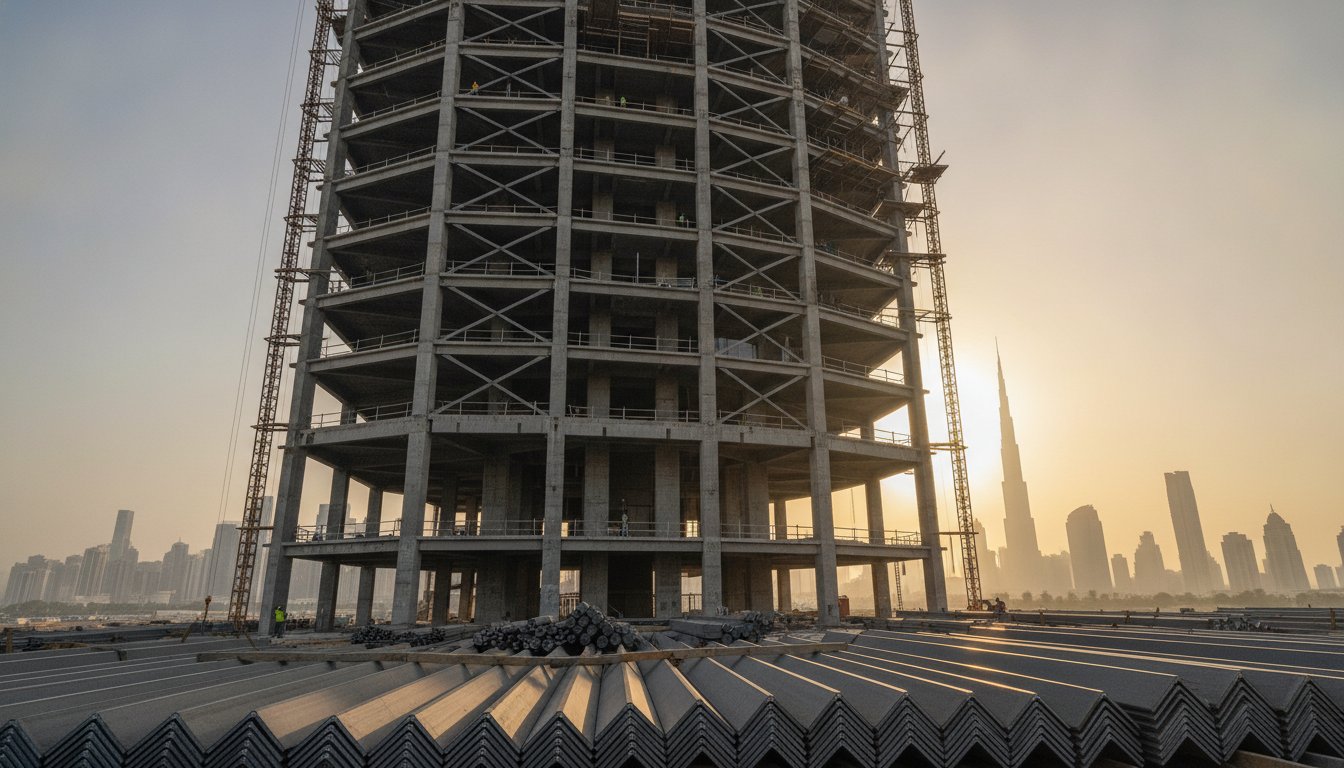
Operational excellence in bulk steel procurement is achieved when the arrival of materials aligns perfectly with project milestones. Implementing a Just-In-Time (JIT) delivery model minimizes the capital tied up in inventory and reduces the physical footprint required for on-site storage. This synchronization is particularly vital for large-scale GCC infrastructure where space is at a premium and project timelines are aggressive. You don't just buy steel; you manage its flow through the supply chain to ensure it's available exactly when the structural assembly begins.
Protecting Material Integrity During Storage
Maintaining the quality of your inventory requires strict adherence to storage protocols. Galvanized Coils (GI) and Cold Rolled (CR) coils are highly susceptible to white rust if exposed to moisture or humidity fluctuations. They must be stored in temperature-controlled, dry environments with adequate ventilation. For structural components like HEA/HEB beams and IPE sections, stacking protocols are essential to prevent deformation. Beams should be supported at regular intervals to maintain their camber and alignment. Hot Rolled (HR) products, while more robust, still require protection from the high-salinity air common in coastal GCC regions to prevent premature surface oxidation.
Streamlining Final-Mile Delivery Logistics
The final leg of the journey often presents the most complex challenges. Coordinating heavy-lift transport for over-length I-beams or large-diameter pipes requires specialized equipment and precise scheduling. You must verify site-readiness before the arrival of bulk shipments to avoid costly standby charges for transport fleets that can reach thousands of Dirhams (AED) per day. This includes ensuring crane capacity and clear access routes for articulated vehicles. Consolidated shipping across the supply chain significantly reduces the carbon footprint of bulk steel procurement by maximizing vessel and vehicle utilization.
Managing dead stock is another critical aspect of operational efficiency. By implementing a strategic inventory release plan, you can ensure that older stock is utilized first, preventing the long-term degradation of materials stored in the yard. This methodical approach ensures that every ton delivered to the site meets the highest standards of structural integrity. If you're looking to optimize your project timeline with reliable supply, you can partner with a distributor that specializes in precision logistics and JIT delivery.
Saffron Steel: Your Partner in National Steel Distribution
Saffron Steel LLC operates as a cornerstone of the UAE industrial sector, providing the infrastructure and expertise required for seamless bulk steel procurement. Our authoritative presence in national distribution is built on a foundation of industrial precision and a deep understanding of the GCC market. We don't just supply materials; we act as a strategic partner that manages the inherent complexities of global trade, allowing your team to focus on project execution rather than supply chain disruptions.
Our comprehensive inventory covers the full spectrum of flat and long steel products. Whether your project requires high-volume orders of Galvanized Coils (GI) for facade systems or heavy-duty HEA/HEB structural beams for high-rise frames, we maintain the stock levels necessary to meet immediate demand. This breadth of inventory ensures that Saffron Steel LLC remains a single-source solution, eliminating the administrative burden of managing multiple vendors for a single project. Our commitment to reliability ensures that every ton delivered meets the specific technical standards your engineers demand.
A Single-Source Solution for Diverse Steel Needs
Our global mill network spans Europe, Asia, and the MENA region, ensuring a consistent supply of materials even during periods of global market volatility. This network allows us to offer custom sourcing capabilities for complex, project-specific requirements that fall outside standard classifications. Our team provides technical advisory services to help procurement teams select the optimal steel grade, ensuring that every ton of steel meets the mechanical and mechanical standards required for the harsh GCC environment. You can explore our range of GI Coils to see how our specifications align with your technical needs.
Reliability in Every Ton: The Saffron Steel LLC Logistics Engine
Managing the logistical intricacies of bulk steel procurement requires a methodical approach to documentation and transport. Saffron Steel LLC handles the entire process, from production monitoring at the mill to final-mile delivery at your site. We ensure that every shipment is accompanied by full Mill Test Certificate (MTC) compliance and all necessary regional documentation, facilitating smooth audits and zero-defect handovers. This meticulous care extends to our logistics engine, which is designed to handle multi-thousand ton orders with the same precision as a single bundle.
Our commitment to excellence extends to our pricing models. By leveraging our wholesale volume and global relationships, we provide competitive bulk pricing that protects your project's ROI. We understand that in a market where Turkish rebar prices can fluctuate between 2,112 AED and 2,148 AED per ton, stability and predictability are your most valuable assets. Contact Saffron Steel LLC for a strategic bulk procurement consultation to secure your 2026 supply chain and ensure your project remains on schedule and within budget.
Securing Your 2026 Infrastructure Supply Chain
Success in bulk steel procurement now depends on the ability to integrate technical precision with global supply chain foresight. By adhering to a rigorous checklist that prioritizes ASTM and EN compliance alongside strategic sourcing from Europe, Asia, and the MENA region, you can effectively mitigate the risks of price volatility and material non-conformity. We've established that the path to project ROI lies in the synchronization of mill production with Just-In-Time delivery schedules across the GCC.
Saffron Steel acts as your strategic partner in this complex environment, providing the authoritative expertise required to manage large-scale industrial orders. Our comprehensive inventory and specialized logistical capabilities ensure that your structural beams and coils are handled with meticulous care from the furnace to the site. We provide the full traceability and documented quality assurance necessary for modern infrastructure audits, ensuring every component meets your exact specifications.
Partner with Saffron Steel for Reliable Bulk Procurement to ensure your next project is grounded in reliability and industrial excellence. Let's move forward with the confidence that your supply chain is as strong as the steel we deliver.
Frequently Asked Questions
What are the primary factors influencing bulk steel prices in 2026?
Global mill output, energy surcharges, and geopolitical events are the primary drivers. In 2026, the shift toward standardized greenhouse gas measurement, which now covers approximately 60% of global production, has added new compliance costs to the supply chain. Additionally, sustained regional infrastructure demand in the GCC keeps local inventory levels tight. Monitoring these variables is essential for any bulk steel procurement strategy to ensure project budgets remain within their initial projections.
How do I verify the authenticity of a Mill Test Certificate (MTC)?
Verification requires a direct correlation between the physical material and the provided documentation. You must check the heat number stamped on the beams or coils against the specific data listed on the MTC. Authentic certificates include the mill's official stamp, chemical analysis, and mechanical test results. For large-scale orders, digital verification through mill portals provides an extra layer of security, ensuring that the material meets the zero-defect standards required for national infrastructure.
Is it better to source steel from European or Asian mills for GCC projects?
Selecting a sourcing region depends on your project's technical and budgetary priorities. European mills are often the benchmark for high-tolerance structural sections like HEA or HEB beams, where EN 10025 compliance is critical. Asian mills offer significant cost-efficiency for massive volumes of GI or HR coils. A balanced bulk steel procurement approach often utilizes both regions, optimizing for specialized quality in core structural components while leveraging Asian production for high-volume flat products.
What are the storage requirements for Galvanized Coils to prevent damage?
Galvanized Coils must be stored in dry, well-ventilated, and temperature-controlled environments to prevent the formation of white rust. Exposure to moisture or high humidity, common in coastal GCC areas, causes rapid surface oxidation. Coils should be stored on racks or pallets to avoid direct contact with the ground, which prevents moisture wicking. Regular inspections are necessary to ensure that protective packaging remains intact until the material is ready for use on-site.
Can Saffron Steel handle custom sourcing for non-standard structural sections?
Saffron Steel specializes in custom sourcing for non-standard structural sections that fall outside regular inventory profiles. Leveraging our global mill network across Europe and Asia, we can procure specialized dimensions or grades required for complex engineering designs. This service ensures that even the most unique project requirements are met without compromising on technical compliance or delivery timelines, providing a single-source solution for every component of the structural frame.
How does bulk procurement impact project timelines in the UAE?
Bulk procurement significantly streamlines project timelines by eliminating the uncertainty of the spot market. By securing materials in advance, you avoid the lead-time delays associated with mill production slots and international shipping bottlenecks. In the UAE, where construction schedules are aggressive, having a pre-secured inventory of rebar and beams ensures that site work never pauses due to material shortages, effectively protecting the project from expensive downtime and logistical delays.
What are the most common ASTM grades used in regional infrastructure?
ASTM A36 is the most prevalent grade for structural steel applications in the GCC due to its versatility and weldability. For reinforcement, ASTM A615 Grade 60 is the standard for deformed rebar in high-rise construction. Additionally, ASTM A53 is commonly specified for pipes and tubes in industrial infrastructure projects. These standards ensure that materials possess the mechanical properties required to withstand the high-load and environmental stresses specific to regional construction projects.
How can I hedge against currency fluctuations in international steel trading?
Hedging against currency volatility involves utilizing forward contracts and fixed-price supply agreements. By locking in pricing in UAE Dirhams (AED) at the start of a procurement cycle, you eliminate the risk of international currency shifts impacting your final landed cost. This methodical approach provides budgetary certainty for multi-year projects, ensuring that fluctuations in the global market don't result in unexpected costs that could jeopardize the financial viability of the infrastructure build.
Frequently Asked Questions
Global mill output, energy surcharges, and geopolitical events are the primary drivers. In 2026, the shift toward standardized greenhouse gas measurement, which now covers approximately 60% of global production, has added new compliance costs to the supply chain. Additionally, sustained regional infrastructure demand in the GCC keeps local inventory levels tight. Monitoring these variables is essential for any bulk steel procurement strategy to ensure project budgets remain within their initial projections.
Verification requires a direct correlation between the physical material and the provided documentation. You must check the heat number stamped on the beams or coils against the specific data listed on the MTC. Authentic certificates include the mill's official stamp, chemical analysis, and mechanical test results. For large-scale orders, digital verification through mill portals provides an extra layer of security, ensuring that the material meets the zero-defect standards required for national infrastructure.
Selecting a sourcing region depends on your project's technical and budgetary priorities. European mills are often the benchmark for high-tolerance structural sections like HEA or HEB beams, where EN 10025 compliance is critical. Asian mills offer significant cost-efficiency for massive volumes of GI or HR coils. A balanced bulk steel procurement approach often utilizes both regions, optimizing for specialized quality in core structural components while leveraging Asian production for high-volume flat products.
Galvanized Coils must be stored in dry, well-ventilated, and temperature-controlled environments to prevent the formation of white rust. Exposure to moisture or high humidity, common in coastal GCC areas, causes rapid surface oxidation. Coils should be stored on racks or pallets to avoid direct contact with the ground, which prevents moisture wicking. Regular inspections are necessary to ensure that protective packaging remains intact until the material is ready for use on-site.
Saffron Steel specializes in custom sourcing for non-standard structural sections that fall outside regular inventory profiles. Leveraging our global mill network across Europe and Asia, we can procure specialized dimensions or grades required for complex engineering designs. This service ensures that even the most unique project requirements are met without compromising on technical compliance or delivery timelines, providing a single-source solution for every component of the structural frame.
Bulk procurement significantly streamlines project timelines by eliminating the uncertainty of the spot market. By securing materials in advance, you avoid the lead-time delays associated with mill production slots and international shipping bottlenecks. In the UAE, where construction schedules are aggressive, having a pre-secured inventory of rebar and beams ensures that site work never pauses due to material shortages, effectively protecting the project from expensive downtime and logistical delays.
ASTM A36 is the most prevalent grade for structural steel applications in the GCC due to its versatility and weldability. For reinforcement, ASTM A615 Grade 60 is the standard for deformed rebar in high-rise construction. Additionally, ASTM A53 is commonly specified for pipes and tubes in industrial infrastructure projects. These standards ensure that materials possess the mechanical properties required to withstand the high-load and environmental stresses specific to regional construction projects.
Hedging against currency volatility involves utilizing forward contracts and fixed-price supply agreements. By locking in pricing in UAE Dirhams (AED) at the start of a procurement cycle, you eliminate the risk of international currency shifts impacting your final landed cost. This methodical approach provides budgetary certainty for multi-year projects, ensuring that fluctuations in the global market don't result in unexpected costs that could jeopardize the financial viability of the infrastructure build.